Students for a Democratic Society (SDS)
The Council on American-Islamic Relations (CAIR) publicly describes itself as a Muslim civil-rights organization. The organization’s documented history, leadership record, and institutional affiliations, however, contradict that portrayal.
Rather than operating primarily as a neutral civil-rights body, CAIR functions as a political advocacy organization with deep roots in Islamist networks and an expanding footprint on U.S. college campuses, where it influences student activism, campus protest narratives, and university policy decisions.
CAIR’s role in higher education must be evaluated in light of its founders’ documented ties to Hamas-aligned organizations, its designation as an unindicted co-conspirator in the Holy Land Foundation terrorism-financing case, and its leadership’s repeated defense of extremist actors and rhetoric.
This page documents CAIR’s background, leadership, and campus involvement using publicly available reporting and court records.
CAIR claims to advocate for civil rights and religious freedom. The public record shows:
These facts are central to understanding why CAIR’s presence on college campuses is controversial and why universities’ reliance on CAIR as a civil-rights authority is increasingly questioned.
According to the Institute for National Security Studies (INSS), CAIR has documented associations with the Muslim Brotherhood, an Islamist movement whose ideology has influenced multiple U.S.-based political organizations.
CAIR’s founders previously held leadership roles in the Islamic Association for Palestine (IAP), an organization that functioned as a Hamas-aligned media and advocacy outlet in the United States. IAP distributed antisemitic materials, employed senior Hamas figures, and was later dissolved following legal scrutiny related to terrorism financing.
CAIR is also a key partner in the U.S. Council of Muslim Organizations (USCMO), a coalition formed by groups identified by researchers as having ties to political Islam. Analysts have described USCMO as part of a strategic rebranding effort following increased exposure of Islamist networks operating in the U.S.
In the 2009 retrial of the Holy Land Foundation (HLF), the largest terrorism-financing prosecution in U.S. history, CAIR was named as an unindicted co-conspirator.
HLF was convicted of funneling millions of dollars to Hamas, a U.S.-designated terrorist organization. CAIR was named due to its documented links to the Palestine Committee, a Hamas-connected network operating in the United States.
As a direct result of evidence introduced at trial:
Although CAIR was not criminally charged, the federal government’s decision to sever ties remains a defining marker of the organization’s standing.
CAIR’s modern influence is most visible in college and university environments, where it operates as a political actor rather than a neutral rights organization.
CAIR and its regional chapters are actively involved in:
On campuses, CAIR is frequently presented as a civil-rights authority despite its leadership’s history of extremist rhetoric and its unresolved federal record.
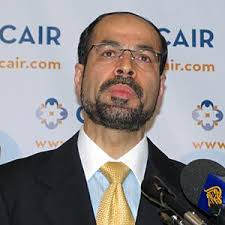
Nihad Awad is a co-founder and longtime executive leader of CAIR. Prior to CAIR’s creation, he served as public relations director for the Islamic Association for Palestine, an organization tied to Hamas leadership and later dissolved.
Awad has publicly praised Hamas actions, accused AIPAC of controlling the U.S. government, and described Israel as a threat to global peace. After Awad celebrated Hamas’s October 7 attack as an act of “breaking the siege,” the White House publicly condemned his statements. Following backlash, CAIR was removed from federal antisemitism counterstrategy materials, according to reporting by the Foundation for Defense of Democracies.
Omar Ahmad, a co-founder of CAIR, previously served as president of the Islamic Association for Palestine. FBI records cited by investigators describe Ahmad as having sought Muslim Brotherhood approval to establish CAIR.
Ahmad was named an unindicted co-conspirator in the Holy Land Foundation case. Documentation shows he solicited donations for HLF and coordinated fundraising efforts. Ahmad has publicly denied supporting Hamas.

Rabih Haddad served as a fundraiser for CAIR-Ann Arbor. He co-founded the Global Relief Foundation, which the U.S. Treasury Department designated as a terrorist organization for financing al-Qaeda and maintaining ties to Osama bin Laden and Taliban officials. Haddad was arrested in 2001 and deported.

Zahra Billoo, executive director of CAIR-San Francisco Bay Area, has equated Israel with Nazi Germany, defended Hamas and Hezbollah, supported the Holy Land Foundation, and publicly targeted Jewish and Zionist institutions.
Dawud Walid, executive director of CAIR-Michigan, has defended Hamas’s inclusion in peace talks, downplayed terrorist violence, and publicly challenged FBI counterterrorism prosecutions as entrapment.
Hussam Ayloush, executive director of CAIR-Los Angeles, has equated Israel with Nazi Germany, promoted anti-Israel conspiracy theories, supported BDS activism, and engaged in rhetoric described as incitement.
CAIR is not a neutral civil-rights organization. It is a politically active group with documented ties to Islamist networks and a leadership record that includes defense of extremist actors.
Its expanding role on U.S. college campuses makes transparency essential. Universities that rely on CAIR without acknowledging its documented history risk legitimizing an organization whose record contradicts its public branding.