Students for Justice in Palestine


Non-Profit Organization

United States,Canada,Europe

Active

What is Students for Justice in Palestine’s Mission?

Students for Justice in Palestine (SJP) is a national campus activist network organizing pro-Palestinian advocacy across U.S. universities. While it presents itself as a student movement for Palestinian rights, it functions as a coordinated pressure campaign targeting university investments, policies, and public positioning on Israel and serving as a campus engine for the Boycott, Divestment, and Sanctions (BDS) movement alongside groups such as Jewish Voice for Peace.

But in recent years, multiple SJP chapters have escalated into encampments, sometimes violent building occupations, and tactics that universities say went against conduct codes, interfered with academic operations, or created safety risks. Their protest activity has been shown to cross over into trespassing, vandalism, harassment, or obstruction that violates university rules and even state law.

What is Students for Justice in Palestine’s Founding History?

Students for Justice in Palestine was founded in 1993 at the University of California, Berkeley as a campus-specific extension of nationwide pro-Palestinian advocacy. It was co-founded by Hatem Bazian, now chairman of American Muslims for Palestine.

Image of Hatem Bazian of Students for Justice in Palestine

The Berkeley chapter lost its official university recognition in 1999, but its status was restored around 2001 during the Second Intifada and in 2002, it organized the first National Student Conference of the Palestine Solidarity Movement. It was banned from UC Berkeley in 2002 after students occupied a university building and arrests were made, but regardless, by 2011, SJP was holding formal national conferences and operating as a coordinated, multi-campus entity.

From the outset, SJP was built as an organizing infrastructure, not just a campus discussion group.


What Are Notable Controversies Surrounding Students for Justice in Palestine Chapters?

Columbia University (SJP/CUAD)

At Columbia University, SJP became a central driver of post-October 7th campus unrest. Working through Columbia University Apartheid and Divest (CUAD), which has posted statements such as “We are Westerners fighting for the total eradication of Western civilization”, the chapter moved from demonstrations to encampments and ultimately the occupation of an academic building. In doing so, Columbia became a national flashpoint for how universities respond when protest tactics escalate.

  • October 12, 2023 – just days after the events of October 7th, Columbia SJP, alongside JVP, organized a walkout and protest on the Low Memorial Library steps.
  • Mid-November 2023 – SJP and JVP were both suspended by Columbia for policy violations and “threatening rhetoric and intimidation.”
  • April 17, 2024 – an unauthorized, pro-Palestine encampment was established on East Butler Lawn by SJP and CUAD.
  • April 18, 2024 – the Butler encampment was dismantled by police, who made 110+ arrests.
  • April 30, 2024 – Hamilton Hall was occupied and cleared by NYPD with 100+ arrests. Students vandalized Columbia property, breaking windows and barricading doors.
  • Mid-2025 – nearly 80 students were sanctioned, including suspensions, expulsions, probation, and degree revocations.

In August of 2024, just months after the encampments, then-President of Columbia University Minouche Shafik resigned, citing the “considerable toll” of the “period of turmoil where it has been difficult to overcome divergent views across our community.”
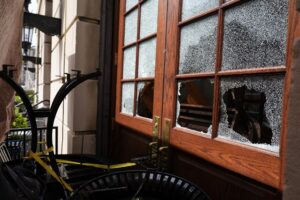
Image of student vandalism during Columbia SJP occupation Image of students barricading doors inside Columbia University Image of Columbia student in a keffiyah smashing a university window

University of California, Irvine (UCI SJP)

At the University of California, Irvine, SJP aligned with the UCI Divest Coalition and helped lead the 2024 pro-Palestine encampment effort. The events that followed were part of the pattern of what was unfolding nationally: establish encampment, receive administrative warning, police removal, then mobilize against disciplinary action.

  • April 29, 2024 – an unauthorized encampment was launched and subsequently included occupation of a university building, to which University Chancellor Howard Gillman said, “What a sad day for our university. I’m brokenhearted. After weeks when the encampers assured our community that they were committed to maintaining a peaceful and nondisruptive encampment, it was terrible to see that they would dramatically alter the situation in a way that was a direct assault on the rights of other students and the university mission.”
  • May 15, 2024 – the encampment was dismantled by police, who made 47 arrests, including non-students after being called-for by the university.
  • May 22, 2024 – SJP organized a walkout protesting 14-day suspensions applied to the protesters.

The presence of outside participants in the encampments and university building barricades raised concerns about trespass and campus security – issues that are a liability for any university.

Image showing a confrontation between police and pro-Palestinian protesters at UC Irvine Image showing a pro-Palestine encampment at UC Irvine


University of Wisconsin–Madison (UW–Madison SJP)

At the University of Wisconsin–Madison, SJP led an almost two-week-long encampment on the Library Mall during the 2024 protest wave. While it ended in negotiation rather than mass arrests, it still tested university limits on use of campus property.

  • April 29, 2024 – the encampment was established.
  • Early May 2024 – police temporarily disrupted the encampment.
  • May 10, 2024 – the encampment was removed after SJP came to an agreement with the university. The agreement, which is likely not a legally enforceable contract, according to Marquette Law Professor Nadelle Grossman, had SJP agreeing to disband the encampment and promise to “refrain from disruption of any university operation” in exchange for UW-Madison committing to “enhance its engagement with and support for scholars and students impacted by war, violence, occupation and displacement, including in places such as Gaza.”

Encampments consistently raise questions about unauthorized occupation and disruption of campus functions, and the “agreement” reached in UW-Madison’s case raises serious flags about a university capitulating to students on campus who engage in extreme discourse.

Image of the pro-Palestine encampment at UW Madison Image of pro-Palestine supporters confronting police at UW Madison


Swarthmore College (Swarthmore SJP)

At Swarthmore College, SJP organized a short-lived, four-day encampment that ended in nine arrests. Most of those arrested were not current Swarthmore students, complicating claims that the protest was purely internal campus activism.
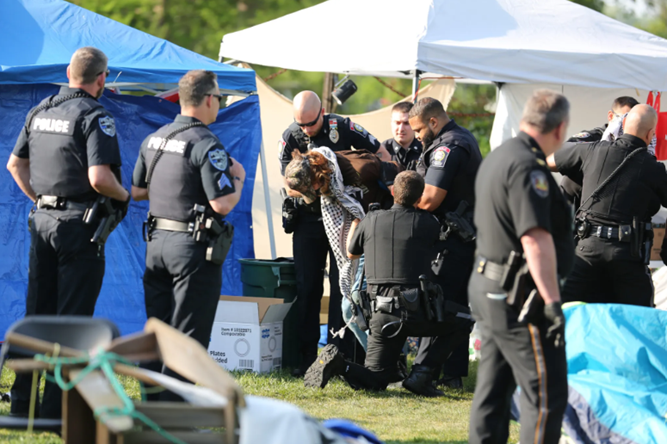
Image showing arrests made at Swarthmore Students for Justice in Palestine encampments


University of California, Los Angeles (UCLA SJP/Graduate SJP)

At the University of California, Los Angeles, SJP activity extended beyond campus grounds and into serious, private residential protest. The February 2025 demonstration outside the home of Jewish UC Regent Jonathan Sures triggered swift administrative response and ultimately one of the most severe bans imposed on any SJP chapter.

  • February 5, 2025 – a protest of 50-100 people was held outside Sures’ home, during which the street was blocked, and his home was vandalized with red handprints smeared on his walls. Sures believed he was targeted for being Jewish, and said “It’s one thing to peacefully protest, but to go to an administrator or a regent’s house …to surround my wife’s car and prevent her from free movement, and to put up signs, threatening my family and my life and vandalize the house, that is a big escalation.”
  • February 12, 2025 – as a result, UCLA Chancellor Julio Frenk suspended (in interim) both SJP and Graduate SJP of UCLA.
  • February 18, 2025 – around 150 protesters gathered on the UCLA campus to protest the suspensions.
  • March 2025 – UCLA subsequently indefinitely banned SJP, while Graduate SJP was banned for four years.

Blocking residential access and defacing property moves a protest beyond campus jurisdiction and into potential criminal territory under state law.

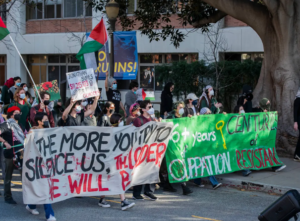
Image showing UCLA Students for Justice in Palestine protesting Jonathan Sures home Image showing UCLA Students for Justice in Palestine protesting their suspension Image showing UCLA Students for Justice in Palestine


How Have Students for Justice in Palestine Chapters Been Disciplined?

Numerous SJP chapters have faced suspension, revocation, probation, or court-ordered reinstatement:

  • Columbia University – Suspended November 2023; remains suspended
  • George Washington University – Suspended April 2025; extended through spring 2027
  • University of California, Los Angeles – Suspended February 2025; indefinite revocation March 2025
  • University of Pittsburgh – Interim suspension March 2025; reinstated September 2025 by federal judge
  • Brown University – Suspended October 2024; re-recognized May 2025 on probation
  • Temple University – Interim suspension October 2024; remains suspended
  • Swarthmore College – Suspended February 2025; remains suspended
  • Bowdoin College – Charter revoked through at least 2025–2026
  • University of Wisconsin–Madison – Suspended July 2025; suspended “until 2026”
  • Rowan University – Suspended February 7, 2025; reinstated February 17, 2025
  • DePaul University – Suspended January 2026; suspended until fall 2027
  • University of Louisville – Interim suspension October 2025; status unclear
  • George Mason University – Suspended 2024–2025 academic year; later reinstated


Conclusion: Students for Justice in Palestine is an Escalating Liability

Students for Justice in Palestine has evolved from a single campus chapter at UC Berkeley into a national protest network that repeatedly tests university boundaries. Across multiple campuses, the pattern is consistent: high-visibility activism, escalation into disruptive tactics, administrative sanctions, and in some cases police involvement. It is not about whether students can protest. It is about whether occupying buildings, blocking access, vandalizing property, or targeting private residences falls within protected campus activism. Suspensions and bans of SJP continuing nationwide suggest these actions fall firmly under unauthorized territory that violates university policy.