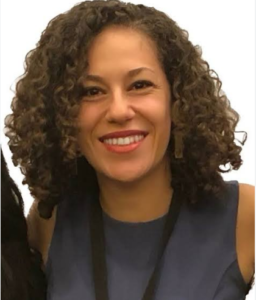
Who Is Nour Joudah?
Nour Joudah is an Assistant Professor in UCLA’s Department of Asian American Studies whose academic career comes with a heavy side of pro-Palestinian activism. She has ties to the Journal of Palestine Studies, Faculty and Staff for Justice in Palestine (FSJP), and the Foundation for Middle East Peace. Her record includes praising campus encampments, accusing Israel of ongoing genocide, and describing October 7th as a Palestinian “operation” into “occupied lands.”
Her presence in UCLA classrooms calls into serious question the neutrality present there. Will her students receive an unbiased perspective? Or will Nour Joudah’s support for October 7th become the de-facto attitude in the Asian American Studies department?
How Has Nour Joudah Described October 7th and Israel?
Joudah has repeatedly described Palestinians as the rightful people of the land while brushing aside the Jewish connection to Israel. Her claim that “the whole nation is in exile” presents Palestinians as the real displaced nation and leaves Jewish history in the region conveniently out of the picture.

- May 2025 – posted that Israel’s “guiding logic of elimination” was “ethnic cleansing.”
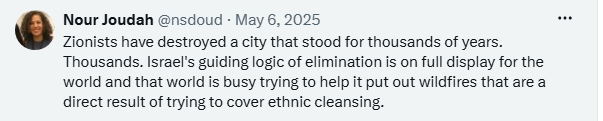
Subtle she is not.
How Is Nour Joudah Connected to Pro-Palestinian Organizations?
Joudah’s activism does not exactly stop at the classroom door. She has held roles with several organizations involved in Palestinian advocacy, academic publishing, and policy work.
The pattern is not especially difficult to spot: academic role, advocacy organizations, faculty activism, and public political campaigning, all neatly folded into one resume.
How Did Nour Joudah Respond to the Campus Encampments?
In September 2024, Joudah praised the pro-Palestinian campus encampments as “communal and inclusive,” called them successful, and said she was hopeful student activism would continue. Apparently, the blocked access, intimidation, disruption, and hostility reported at several campuses did not make it into her review. Instead, Joudah presented the encampments as a model worth repeating. That fits comfortably with her decision to join Faculty for Justice in Palestine and publicly support student activists. For her, the protests were not a campus crisis. They were a success story.
She also claimed that law enforcement and Zionist organizations were working together to “target student protesters.”
Conclusion: How is Nour Joudah Affecting Neutrality at UCLA?
Joudah is not simply a professor who occasionally posts political opinions. She has joined activist faculty networks, praised disruptive encampments, promoted genocide claims, and described October 7th using the language of Palestinian resistance. For UCLA students, the question is obvious: where does teaching end and activism begin?
Joudah’s public record consistently casts Israel as an illegitimate and violent “Zionist” system while presenting pro-Palestinian activism as justified, effective, and worth expanding. UCLA is not merely employing a scholar who studies Palestine. It is giving a classroom platform to someone already deeply invested in the movement.