Who Is Nathalie Handal?
Born in 1969 in Haiti to a Palestinian family from Bethlehem, Nathalie Handal is an poet and professor whose work centers on Palestinian exile, displacement, and, notably, criticism of Israel. Once a professor of comparative literature and creative writing at Columbia University, she now works at NYU Abu Dhabi as a professor of literature and creative writing. She has authored books such as Life in a Country Album, recipient of the Palestine Book Award, and both her literary voice and academic platform are closely intertwined with a consistent bias regarding Israel.
Nathalie Handal’s Public Statements and Political Activity
- July 2014: Published three poems during “Operation Protective Edge” focusing on Gaza and attributing civilian suffering solely to Israeli military action.
- 2014: Shared content supporting Gaza and criticizing Israel, including posting the video “Freedom for Palestine – One World.”
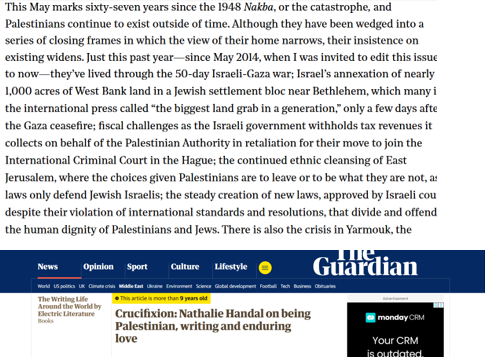
- 2015: Authored essays sharply criticizing Israeli policies, including movement restrictions, settlements, and Palestinian displacement.
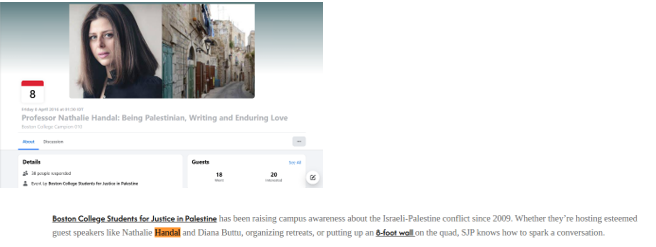
- April 2016: Participated in an event hosted by Boston College Students for Justice in Palestine, discussing her experiences in Palestine and how conflict shapes her writing.
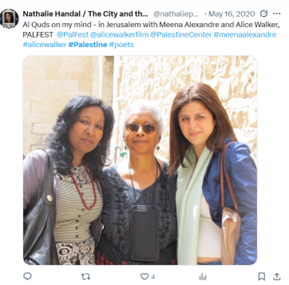
- 2020: Visited Israel in the scope of PalFest, the Palestine Festival of Literature
- May 2024: Participated in a Zoom session with students from Al Quds University titled “Nathalie Handal: Writing Out of Place.”
Although her recent social media activity has been limited, her published work and public engagements consistently emphasize themes critical of Israel.
Conclusion: Nathalie Handal’s Personal Themes Versus Her Academics
Nathalie Handal’s poetry portrays the “trauma” of Palestinian identity as a direct result of Israeli policy and action. Her framing tends to present a single narrative of the conflict, with limited input from dissenting historical or political perspectives. As these themes are present in both her literary works and her public academic appearances, the distinction between Handal’s own expression and ideological support is difficult to separate within her capacity as a university educator. And when a faculty member’s own work consistently advances a particular interpretation and critical bias, their point of reference in the classroom deserves to be questioned.