Who Is Sahar Aziz?
Sahar Aziz, a Distinguished Professor at Rutgers Law, has translated her academic credentials into a platform for increasingly radicalized rhetoric. As the Founding Director of the Center for Security, Race, and Rights (CSRR), Aziz has cultivated an environment that many see as a breeding ground for extremist bias. Her consistent habit of rebranding terrorism as “resistance” and dismissing antisemitism as a “Zionist” fabrication suggests a deeper commitment to ideology over legal neutrality. In the high-stakes world of national security and law, her refusal to maintain intellectual boundaries raises a big question: is she training future advocates for justice, or is she mainstreaming extremist narratives within the American legal system?
How Has Sahar Aziz Mainstreamed Extremism?
By leveraging her university platform to amplify radical narratives, Aziz has turned her academic center into a vehicle for extremist outreach. In fact, even outside her own classroom while serving as vice president of the Westfield Board of Education, her rhetoric was the subject of an ethics complaint alleging she equated Zionism with Nazism. Although the case was dismissed on procedural grounds, the commission acknowledged that her words were “controversial and likely perceived as offensive and hurtful to members of the [d]istrict’s Jewish community as well as to the Jewish community as a whole.”
- September 2025 – in a discussion with a “genocide studies” scholar, she argued that the “erroneous IHRA definition of antisemitism” is promoted by “pro-Israeli Zionist special interest groups,” an effort to dismantle the primary legal framework used to identify anti-Jewish hate.
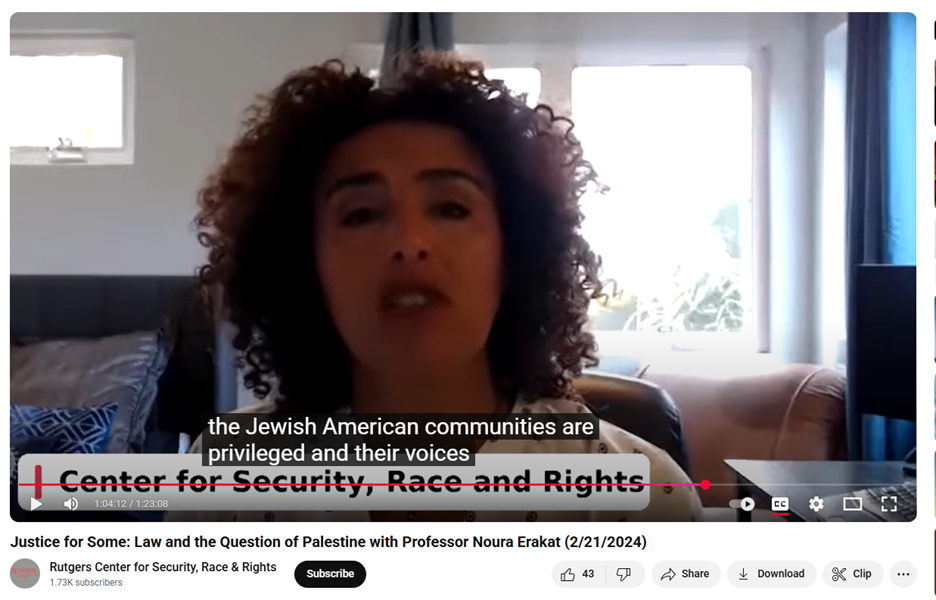
- February 2024 – in a CSRR webinar with Noura Erakat, Aziz stated that “Jewish American communities” benefit from “white privileging” and “white fragility,” using academic jargon to isolate and target a specific minority group – something that seems to violate Title VI of the Civil Rights Act.
- May 2021 – she signed a Rutgers faculty letter defending the “Palestinian right to resistance” during a period of Hamas rocket attacks on Israeli civilians, aligning herself with the same “resistance” rhetoric used by terrorist apologizers.
Has Sahar Aziz Validated Terrorism On Social Media?
Aziz’s digital footprint serves as a masterclass in the defense of radicalized ideologies. She has used her platform to characterize the atrocities of October 7th as a victory and uses her credentials to accuse Israel of genocidal intent while frequently omitting the role of terrorist organizations. Her habit of employing Holocaust inversion – drawing comparisons between the Jewish state and Nazi tactics – is a hallmark of extremist propaganda that certainly calls into question her ability to teach objectively at a public law school.
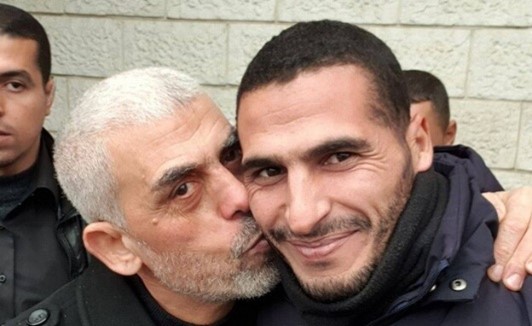
- May 2025 – she reposted a tribute to Hassan Eslayeh, a journalist documented (see below) as appearing alongside Hamas leader Yahya Sinwar, displaying an unsettling comfort with figures firmly rooted in terrorist circles.
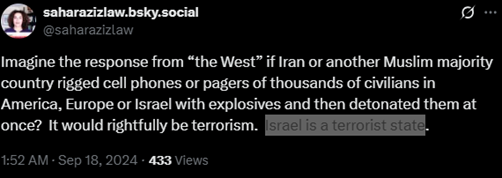
- September 2024 – in a post, she accused Israel of being a “terrorist state” in response to their targeting of known Hezbollah terrorist operatives, as well as falsely labeling those operatives as “civilians.”
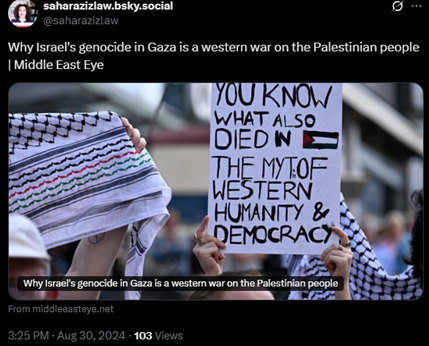
- August 2024 – she shared an article by Joseph Massad that described the October 7th attacks as the “stunning victory of the Palestinian resistance,” a direct validation of mass-scale terrorism.
- October 30, 2023 – in sharing images of Hamas militants breaching the Israeli border, she wrote that the world would rather “show solidarity with our corpses than honor our resistance.” ‘Resistance’ being the murder and hostage-taking of innocent civilians, right?
- October 19, 2023 – just days after October 7th, Aziz reposted content from a protest stating that “#NeverAgain applies to all people,” a tactic of Holocaust inversion used by extremists to diminish the weight of the Holocaust.
- October 11, 2023 – Sahar Aziz shared a lecture with Lara Sheehi titled “Psychoanalysis Under Occupation: Practicing Resistance in Palestine.” Sheehi, a professor at George Washington University, had previously stated that Zionism was “a mental illness.”
Conclusion: Does Sahar Aziz Violate Title VI At Rutgers?
The continued institutional support for Sahar Aziz signals a troubling shift in the standards of Rutgers Law toward a culture of radicalization. This bias has reached the highest levels of government, as the U.S. Senate Judiciary Committee formally called for an investigation into the CSRR, citing its role as a platform for extremist narratives and its history of hosting controversial figures with ties to terrorism. By fostering a climate that minimizes terrorism and targets a specific group based on shared ancestry, Aziz likely violates Title VI of the Civil Rights Act, which prohibits discrimination in programs receiving federal funds. If Rutgers continues to ignore these documented ties to extremist thought, they are not just protecting a professor. They are subsidizing a threat to the civil rights of their own students.