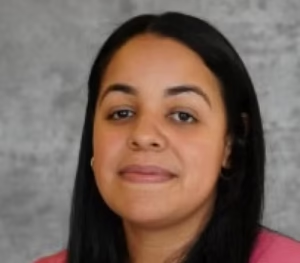
Who Is Sandy Placido?
Sandy Placido is an assistant professor of history at Rutgers University-Newark focused on Latinx and Caribbean studies. That may be her title, but her pattern is something else. Across essays, petitions, and protest campaigns, she consistently shows up in the same place: pushing activist narratives that center Israel as a global villain. It’s a repeat track of boycotts, public statements, organized protests, same direction every time. And when that kind of activism keeps leaking into academic spaces, it raises a simple question: are students getting history, or are they getting a curated worldview? Because when the conclusions are this predictable, it’s not analysis. It’s targeted messaging.
How Has Sandy Placido Engaged in One-Sided Activism and Campaigns?
Placido’s record reads like a checklist of activist alignment: essays pushing sweeping claims, petitions calling for boycotts, and participation in protest campaigns targeting institutions tied to Israel. It’s all a different formats, but with the same conclusion baked in.
- December 2024 – in her essay “For Palestine, from Ayiti,” Placido argues that “violence, apartheid and genocide” faced by Palestinians reflect global systems of racism, drawing parallels to anti-Black discrimination in Haiti and the Dominican Republic and calling for “anti-imperialist, transnational solidarity.” She referenced a gathering held just weeks after October 7th in the Dominican Republic where among those “brought together” were the Communist Party of Labor and the Socialist Workers’ Movement.
- October 2023 – a public statement signed by Placido criticized Rutgers leadership for what was described as a “one-sided” response to the Israel–Hamas conflict, faulting the focus on Israeli victims while not emphasizing Palestinian suffering enough. The letter was also signed by Sahar Aziz and Noura Erakat who have both expressed antisemitic views.
- August 2023 – Placido called for a boycott of the Santo Domingo International Book Fair after Israel was set to be honored, claiming the “tribute clearly serves to culture-wash the apartheid regime in Israel.”

- July 2023 – a statement backed by Sandy Placido told global cultural workers to boycott the Feria Internacional del Libro de Santo Domingo, describing Israel as an “apartheid regime” and calling for coordinated pressure.
- September 2021 – Placido participated in the “Strike MoMA” campaign targeting the Museum of Modern Art included leading a workshop linking a trustee to Barrick Gold, saying “MoMA talks about abstract art while ignoring the reality of dead humans.”
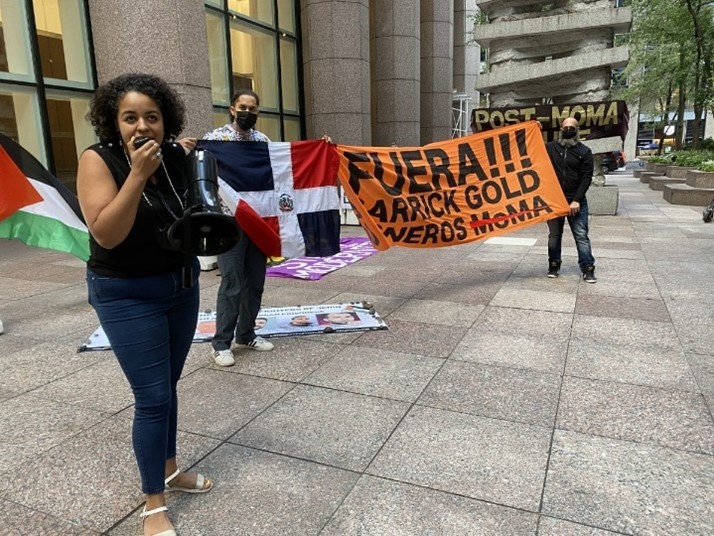
- May 2021 – a public letter signed by Placido targeted the Museum of Modern Art, accusing its board of ties that allegedly support Israeli “colonialism and apartheid,” alongside involvement in early protest actions. The letter referred to the IDF as the “Israeli Occupation Forces.”
- October 2019 – an open letter signed by Placido urged the Latino Commission on AIDS to withdraw from an Israel-sponsored trip, accusing the initiative of “pinkwashing” and saying “to end Israeli apartheid, U.S. organizations, including the Latino Commission on AIDS, must end the support provided by the U.S. government and institutions of the political, military, and financial power that maintains Israeli apartheid.”
Conclusion: What Does Sandy Placido Mean for Rutgers University’s Funding?
Sandy Placido’s track record isn’t subtle. But the issue isn’t that she has views. It’s that those views show up everywhere, across essays, petitions, and protests, with little indication of balance or restraint. At a university like Rutgers that receives federal funding, that matters. Title VI obligations don’t disappear when activism gets rebranded as scholarship. So the question Rutgers has to answer is simple: how much activism is too much when it starts shaping the classroom?