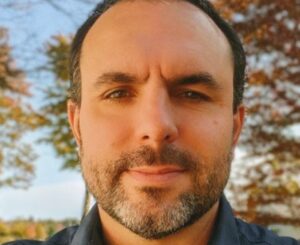
Who Is Sean T. Mitchell?
Sean T. Mitchell is an associate professor of anthropology and the director of Peace and Conflict Studies at Rutgers University–Newark. Sounds like someone who should be all about balance, nuance, and maybe…actual conflict resolution. Instead, his public record reads like a greatest hits of one-sided campus activism, especially when it comes to Israel and Gaza. As a Rutgers AAUP-AFT member, he’s in the same faculty networks that have been defending pro-Palestinian protests while brushing off concerns about antisemitism as overreactions.
When the person running “Peace and Conflict Studies” is this publicly committed to one narrative, what kind of “peace” is actually being taught? And more importantly, what perspectives are getting sidelined?
How Has Sean T. Mitchell Responded to Rutgers Protests, Leadership, and Antisemitism?
Mitchell’s playbook is pretty consistent. Protests? Valid. Crackdowns? Political. Antisemitism concerns? Probably exaggerated. University leadership trying to manage chaos? Not doing enough, apparently.
- May 2024 – in an article co-published with Hank Kalet in “The Progressive Magazine”, Sean T. Mitchell argued that U.S. authorities are suppressing pro-Palestinian speech by labeling it harassment or antisemitism, and called the whole thing “new McCarthyism.” while saying that “Congress and the U.S. Department of Education has opened investigations into numerous schools, using accusations of antisemitism as a pretext.” The same piece framed disruptive encampments – where Jewish students openly stated they were made to feel uncomfortable – at places like Columbia and Rutgers as legitimate activism.
- October 2023 – he signed a public statement criticizing Rutgers’ president for what he saw as a “one-sided” response to the Israel–Hamas conflict, arguing the administration focused too much on Israeli victims and not enough on Palestinian, Arab, and Muslim students. Translation: even attempts at institutional messaging weren’t aligned enough for him. The letter was also signed by Rutgers faculty Sahar Aziz and Noura Erakat, both of whom have been under fire for antisemitic statements and theories.
What Has Sean T. Mitchell Said About Israel and the Gaza Conflict?
If there was any doubt about where Mitchell stands, his public statements clear that up fast. The language is strong, the positions are clear, and neutrality is nowhere to be found.
- October 2023 – just a week after October 7th, Mitchell signed a public statement warning that Israel may be committing “genocide” in Gaza and calling for urgent international intervention. Not exactly a cautious or measured academic take.
- May 2021 – he signed an open letter from Rutgers faculty condemning Israel’s actions as “settler-colonial” and backing calls for “decolonization,” saying the signatories were “in awe of the Palestinian struggle to resist violent occupation, removal, erasure, and the expansion of Israeli settler colonialism.” The letter was also signed by Rutgers professor David Kurnick.
Conclusion: How Can Sean T. Mitchell Impact Rutgers University?
Sean T. Mitchell isn’t just another professor with opinions. He’s running a program that’s supposed to model critical thinking about conflict, power, and resolution. But when accusations of antisemitism are waved off as political tools and disruptive protests are consistently defended, it shapes the educational environment. It tells students which concerns get taken seriously and which ones get reframed out of existence.
And here’s where it gets bigger than Rutgers. Universities are already under federal scrutiny, including Title VI investigations tied to whether Jewish students are being protected. Faculty like Mitchell are part of that equation. Rutgers can keep calling it academic freedom. But at some point, people are going to start asking whether that freedom is coming at the expense of actually maintaining a safe and balanced campus.