Simon & Schuster has a line somewhere. We know because it has dropped authors before.
In 2017, the publisher canceled Milo Yiannopoulos’ Dangerous after old comments resurfaced about sexual relationships between adults and minors. In January 2021, it canceled Senator Josh Hawley’s The Tyranny of Big Tech after the Capitol riot, pointing directly to his role in challenging certification of the 2020 election.
A few months later, the company went even further with Jonathan Mattingly, one of the officers involved in the Breonna Taylor raid. Simon & Schuster wasn’t even publishing his book: it was only supposed to distribute it for conservative publisher Post Hill Press. After backlash, S&S said it wouldn’t distribute the book at all.
So clearly, there are situations where Simon & Schuster decides an author, or the controversy around them, has become too much. But there’s something else that’s hard not to notice. Why do the clearest recent examples keep coming from the same side of the political aisle?
Milo Yiannopoulos: right-wing.
Josh Hawley: Republican senator.
Jonathan Mattingly’s book: published by a conservative press.
That doesn’t automatically prove Simon & Schuster has some official political double standard. But it’s much harder to find a comparable case where a prominent left-wing author lost an already-contracted S&S book because of inflammatory political rhetoric.
Which then brings us to Susan Abulhawa.
Abulhawa has been published by Simon & Schuster imprints, with a new deal announced for September 2026 despite her years of posting and spewing violent antisemitic rhetoric. We’re not talking about one badly worded tweet from years ago. She has compared the Star of David to a swastika. She has called Jews “parasites” and “baby killing demons.” She has spread conspiracy theories about Jewish media control and October 7 being an Israeli offensive:
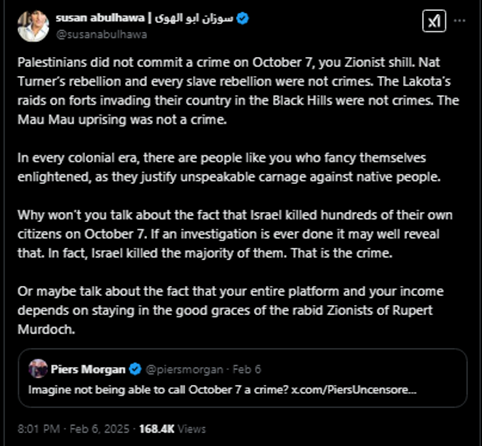

And yet, there doesn’t appear to be the same kind of line in the sand. So what exactly is Simon & Schuster’s standard? And maybe the more uncomfortable question is this: Would Susan Abulhawa still have a publishing relationship if she were a right-wing author making similarly inflammatory comments about another religious or ethnic group?
Publishers are supposed to publish controversial ideas. Sometimes they should defend authors from pressure rather than give in to it. But Simon & Schuster has already shown that it’s willing to make these judgment calls.
Hawley’s conduct was enough. Yiannopoulos’ comments were enough. The controversy around Mattingly was enough for S&S to refuse even to distribute his book. So when Susan Abulhawa repeatedly posts rhetoric like this and nothing comparable happens, people are going to notice.
Maybe Simon & Schuster genuinely believes she hasn’t crossed its line. If so, it should be able to explain where that line is. Because right now, the pattern leaves a pretty obvious question hanging in the air: is Simon & Schuster applying one standard to controversial authors, or does the standard change depending on which side of the political aisle they’re on?