Susan Abulhawa has spent years raging against Jews, Zionists and Israel, often using language so extreme that even being associated with her has apparently started to feel like a liability. Just a small sampling of her posts include:
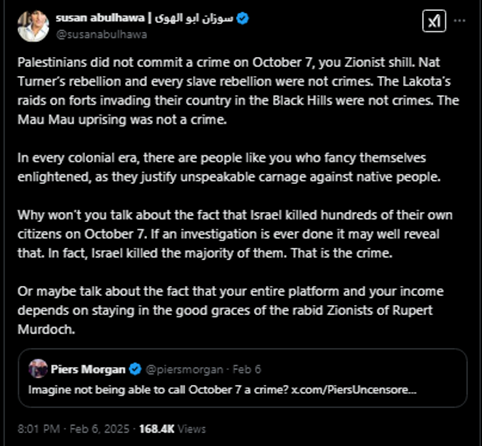
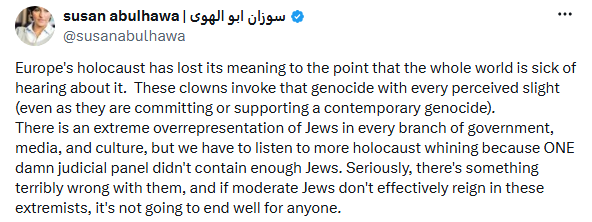
But there’s one place where her ideological purity becomes noticeably more flexible: the publishing industry.
Abulhawa doesn’t just post online. She writes books, sells books, and benefits from the large corporate machinery required to edit, publish, distribute and stock them. And some of the people behind that machinery are exactly the kind of Jewish and pro-Israel figures she spends her time demonizing.
Funny how that works!
Susan Abulhawa’s Books Don’t Publish Themselves
Abulhawa’s novels and other projects have been published through imprints belonging to Simon & Schuster, including Atria Books, Washington Square Press and Simon & Schuster Audio. Her 2026 anthology, Every Moment Is a Life, was published by Atria/One Signal Publishers, while earlier editions of Against the Loveless World were released through Atria and Washington Square Press.
Simon & Schuster was acquired in 2023 by KKR, the global investment firm co-founded by Henry Kravis, in a $1.62 billion transaction. Kravis has supported Israeli cultural institutions through his family foundation. That means the corporate structure helping publish and distribute Abulhawa’s work is tied to a prominent Jewish businessman whose philanthropy has benefited Israel.
Apparently, that’s not a problem when there are books to print.
The Bookstore Problem
Then there’s Barnes & Noble, one of America’s largest booksellers and an obvious retail outlet for an author hoping to reach a broad audience. Barnes & Noble was acquired by Elliott in 2019. Elliott was founded by Paul Singer, whose charitable foundation openly states that its mission includes strengthening the future of Israel as a Jewish and democratic state and supporting Jewish continuity.
Singer also co-founded Start-Up Nation Central, which connects Israel’s technology sector with investors and businesses worldwide.
Again, inconvenient. Abulhawa’s books can be written, published, distributed and stocked through companies connected to Jewish businessmen who’ve supported Israel and Jewish causes. Yet she continues to present Jews and Zionists as some sinister, unified force responsible for everything she dislikes.
The contradiction couldn’t be more obvious.
Susan Abulhawa’s Ideological Purity Ends at the Royalty Check
None of this means an author personally endorses every investment, donation or political opinion connected to a publisher’s owners. Authors generally don’t have control over every company involved in publishing and selling their work. But Susan Abulhawa isn’t known for offering anyone else that kind of nuance. She regularly reduces Jewish and pro-Israel people to sweeping labels, treats association as guilt and speaks as though any connection to Zionism is morally contaminating.
By her own standard, the publishing ecosystem supporting her career should be unacceptable.
She could reject those companies. She could demand that her work be removed. She could search for an ideologically pure publisher, distributor and bookstore network untouched by anyone who supports Israel. Instead, the books remain available. Because apparently Jewish and pro-Israel influence is unforgivable until it’s editing her manuscript, printing the cover, placing the book on a shelf and delivering the royalties. Then it becomes a minor administrative detail.
Susan Abulhawa’s Selective Boycott
Abulhawa wants the posture of total opposition without accepting any of the inconvenience that total opposition would require. She can attack Jews and Zionists in public while benefiting from an industry shaped, funded and supported in part by the very people she condemns.
That’s pretty far from the principled resistance she doubles down on when confronted about complaining about Jews “whining” about the Holocaust.
Her boycott clearly has exceptions. And those exceptions begin wherever her books are being sold.