
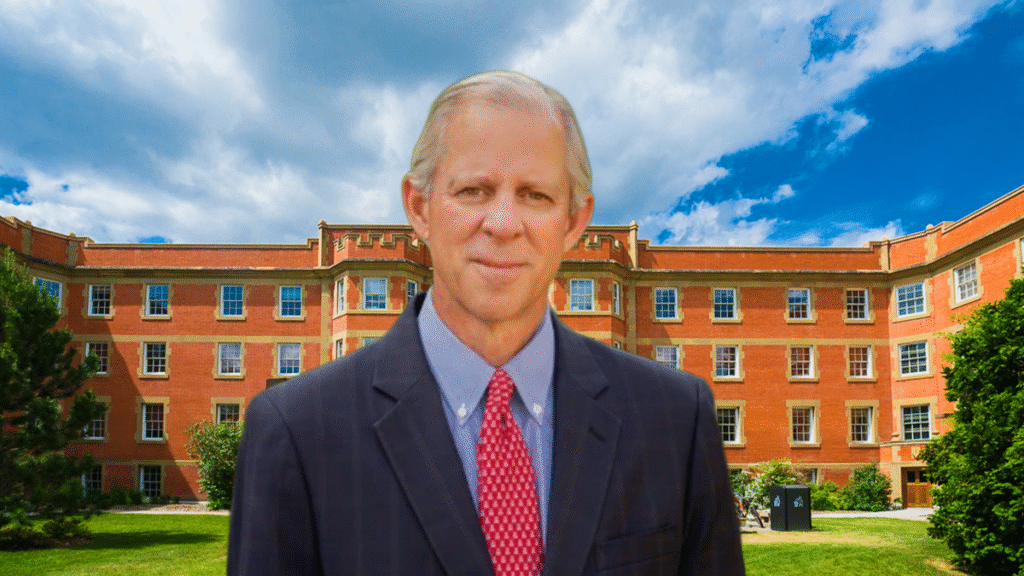
In a year defined by campus chaos and moral hedging, one university president did what so many others refused to: he told the truth.
The Wall Street Journal’s recent editorial praised University of Arizona President Robert Robbins for calling Hamas’s October 7 massacre what it was, “antisemitic hatred, murder, and a complete atrocity.” While presidents from Harvard to Berkeley twisted themselves into moral pretzels to avoid offending activists, Robbins spoke clearly and immediately. In a campus climate where euphemism has become policy, that clarity is newsworthy.
But the real story isn’t just one man’s statement. It’s what his response reveals about how universities can and must draw the line between academic freedom and moral collapse.
The Courage to Name Evil
After October 7, most universities released statements so sanitized they could have been written by AI. “We mourn all loss of life.” “We call for dialogue.” Robbins didn’t hide behind that language. He recognized that the attack on Israeli civilians was not a geopolitical event to “contextualize,” but an act of genocidal antisemitism that demanded moral clarity.
That distinction matters. The University of Arizona is home to one of the largest Jewish student populations in the country. Silence, or false equivalence, would have signaled to those students that their pain was negotiable. Instead, Robbins affirmed what higher education has largely forgotten: that truth and empathy must come before appeasement.

The SJP Problem and the Accountability Gap
The controversy began when the Students for Justice in Palestine (SJP) chapter at Arizona announced a rally days after Hamas’s massacre. Robbins condemned terrorism and warned that the national SJP’s rhetoric, including praise for Hamas’s “resistance,” was “antithetical to our university’s values.”
Within hours, SJP-Arizona cancelled its event, citing “safety concerns.” But Robbins’s statement exposed a nationwide fault line: the disconnect between local student chapters and their national networks. Local SJPs claim independence while benefiting from the same funding pipelines, social-media playbooks, and ideological guidance.
This is the accountability gap that ACT has documented across dozens of campuses. When universities pretend that local chapters operate in isolation, they enable radical activism to flourish under academic branding. Robbins broke that illusion, and the backlash proved why it mattered.
Academic Freedom Isn’t a Shield for Hate
Activists accused Robbins of “chilling free speech.” But free speech was never the issue. The right to protest doesn’t include the right to glorify terrorism or intimidate Jewish students.
Robbins didn’t ban anyone. He simply reminded the campus that freedom comes with responsibility. That’s leadership the kind now absent at many universities under Title VI investigation for antisemitic harassment.

The U.S. Department of Education’s Office for Civil Rights has launched investigations into over sixty universities for failing to protect Jewish students. In contrast, Robbins set a precedent: moral clarity and campus safety can coexist.
What Activist Tracker Sees in This Moment
For Activist Tracker, the Arizona episode is proof that decisive language can restore balance on campus. When leadership speaks clearly, it shifts the power dynamic: suddenly, extremists feel pressure instead of their targets.
Across the country, Activist Tracker has tracked the opposite faculty letters excusing violence, student groups glorifying terror, and administrative silence that masquerades as neutrality. Robbins’s clarity disrupted that normalization. He showed that moral courage still has a place in academia.
A Model for Other Universities
The University of Arizona isn’t perfect, but it proved one thing: universities can defend free speech without abandoning their values.
If other institutions want to follow suit, they must:
- Name the threat without euphemism.
- Protect those most at risk.
- Demand transparency from student organizations.
- Act beyond words with policies, not press releases.
Activist Tracker will continue to track which universities rise to that standard and which hide behind bureaucracy while students face intimidation in the quad.
A Turning Point or a Fluke?
The WSJ was right to praise Robbins, but the question is whether his clarity is a turning point or an exception. If history is any guide, moral courage in higher education is rare. But every act of integrity sets a precedent.
Each time a university leader refuses to play word games with terror, it chips away at the illusion that cowardice equals neutrality. That’s why Activist Tracker will keep spotlighting these cases not as anomalies, but as examples of what real academic leadership looks like when ideology and integrity collide.









