
CU Apartheid Divest group’s messaging mirrors the ideological playbook of the Iranian Revolution, and it warrants scrutiny
52 American diplomats were held captive for 444 days after student protestors in Tehran attacked the U.S. Embassy on November 4, 1979. A new period of ideological conflict between the United States and the Islamic Republic of Iran was ushered in by the event, which became a pivotal milestone in anti-American mobilization. Iran continues to commemorate the occasion as a celebration of “student struggle” and opposition to American “imperialism.”
On social media, Columbia University’s Apartheid Divest group recently repeated that historical narrative, commemorating the anniversary of the embassy takeover and openly supporting the same revolutionary framework. CUAD praised anti-American protests in Iran, called the embassy the “Den of Espionage,” and ended their message with the words “Long live the student struggle.” They stated in a second statement that they wanted to “build an anti-imperialist student movement no matter who is in power.”
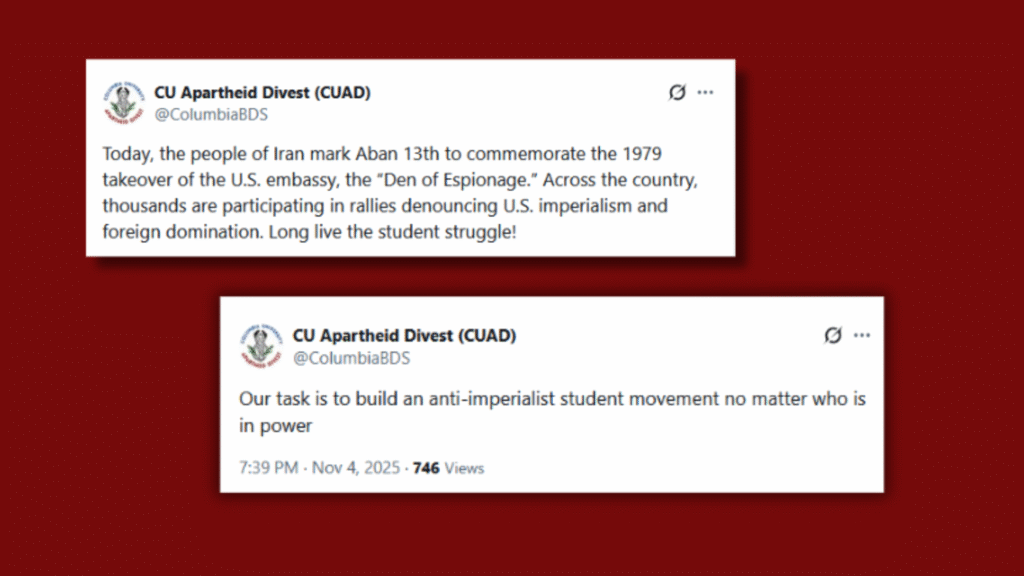
This language is not incidental. It mirrors the symbolism, tone, and operational rhetoric used by the Iranian student revolutionaries who helped usher in a regime openly hostile to the United States. The emphasis on “student revolution,” “anti-imperialism,” and rejecting existing political authority follows a recognizable ideological format rather than a spontaneous expression of campus activism.
Why This Matters
Most discussions about campus activism in recent years have centered around Israel-Palestine dynamics and rising antisemitism. While that issue remains serious, focusing exclusively on it can obscure another emerging trend: the adoption of anti-American ideological frameworks, borrowed directly from revolutionary movements abroad.
Many students may participate in rallies or repost slogans without fully understanding their origins. A protest slogan framed as anti-colonial or anti-authoritarian can sound appealing on the surface. But when those slogans replicate the language and symbolism of movements that actively targeted U.S. citizens and institutions, it becomes harder to treat them as routine campus dissent.
The “no-kings” protest rhetoric seen on multiple campuses fits into this pattern as well. It is positioned as opposition to power structures, yet it carries the same anti-imperialist tone long used by revolutionary movements that have defined themselves through hostility to American institutions. In other words, some participants may believe they are protesting domestic policy or institutional power; in practice, they may be engaging in a political project with a broader ideological lineage than they realize.
The Antifa Parallel
There is an ongoing public debate about whether certain decentralized anti-government movements, often grouped under the label “Antifa,” constitute extremist networks. While federal authorities have not formally designated Antifa as a terrorist organization, public discussion and political advocacy around the issue have intensified. When a campus group adopts language resembling revolutionary anti-state movements, it becomes reasonable to ask whether they are influenced by or aligned with broader ideological ecosystems beyond the university’s setting.
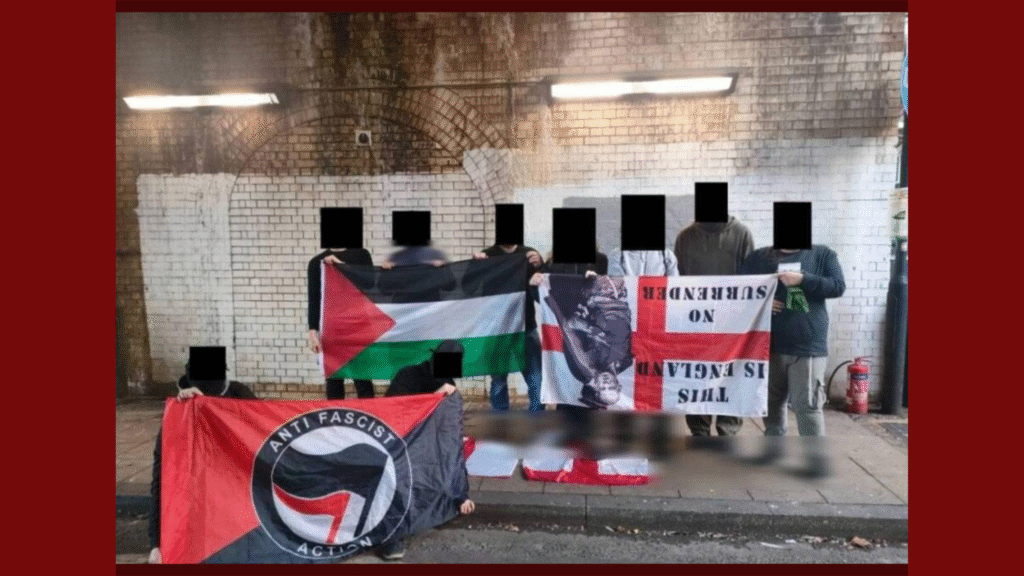
This does not assume guilt or operational connection. It simply recognizes that rhetoric, symbols, and strategic language often signal movement convergence. When a student organization begins using language historically associated with anti-American revolutionary campaigns, it is appropriate to assess context and potential influences.
What Oversight Looks Like
A measured, responsible response does not mean suppressing speech. It means institutions acknowledging the difference between protest and ideological agitation that borrows from historical movements hostile to the United States.
Reasonable steps include:
- Reviewing organizational affiliations and funding streams to ensure transparency
- Assessing messaging patterns to determine whether there is deliberate adoption of foreign revolutionary frameworks
- Clarifying university standards around groups promoting anti-American political narratives modeled on violent historical events
- Ensuring that students understand the ideological lineage of rhetoric they are amplifying
These actions respect free expression while protecting both students and institutional integrity.
A Closing Note
Student activism has always played a role in shaping political culture in the United States. But when student rhetoric explicitly celebrates an attack on U.S. diplomats and embraces the language of foreign revolutionary movements, it crosses into a territory that deserves closer scrutiny.
Calls for investigation are not about punishing speech; they are about transparency, context, and public safety. In an era where foreign influence campaigns, decentralized ideological movements, and rapid information spread coexist, universities and policymakers have a responsibility to understand the environment in which political language circulates.
This moment is not about re-litigating older campus debates. It is about recognizing a different, emerging trend: the normalization of anti-American revolutionary ideology packaged as student activism. If institutions fail to distinguish between the two, they risk misunderstanding the movement taking shape in front of them and misunderstanding the stakes.









