
Universities are supposed to be places where ideas are debated, challenged, and examined through evidence and scholarship. Professors are entrusted with guiding students through complex issues while maintaining intellectual rigor and academic neutrality. But across several American campuses, faculty activists are increasingly using their authority not just to teach, but to mobilize students for political causes, including demonstrations aligned with authoritarian regimes and extremist movements abroad.
In the days following U.S. and Israeli military strikes against Iran that reportedly killed Supreme Leader Ali Khamenei, faculty networks across multiple universities quickly began encouraging student activism in response. Emails and social media posts circulated urging students to attend protests and publicly condemn the military operation. Much of this messaging came from faculty affiliated with Faculty for Justice in Palestine (FJP), a network of professors that has become increasingly active in campus political organizing.
For critics, the episode highlights a deeper concern that has been growing across higher education: the powerful role faculty play in shaping, legitimizing, and accelerating student activism.
Professors Recruiting Students for Anti-U.S. Protests
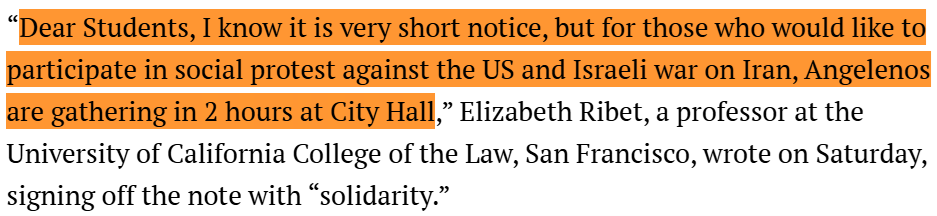
One example that quickly drew attention came from Elizabeth Ribet, a professor at the University of California College of the Law, San Francisco. Ribet emailed students urging them to attend a protest in Los Angeles against what she described as the “U.S. and Israeli war on Iran.”
“Dear Students, I know it is very short notice, but for those who would like to participate in social protest against the US and Israeli war on Iran, Angelenos are gathering in 2 hours at City Hall,” she wrote, signing the message with the word “solidarity.”
Critics argue that emails like this illustrate a troubling trend: professors using their institutional authority and direct access to students to recruit participants for political demonstrations.
Tammi Rossman-Benjamin, executive director of the campus watchdog organization AMCHA Initiative, described the message as a clear example of the line between teaching and activism being crossed. According to Rossman-Benjamin, faculty communications that encourage political mobilization risk turning academic spaces into platforms for ideological advocacy rather than scholarship.
Faculty Networks Amplifying Pro-Iran Messaging
Ribet’s email was not an isolated incident. In the days following the strikes, a number of faculty organizations and academic groups posted messages expressing solidarity with Iran while condemning the United States and Israel.
One widely circulated post claimed that U.S.-backed attacks were designed to ignite a broader regional war and accused the United States and Israel of seeking domination across the Middle East. The message framed the conflict as part of a larger struggle against imperialism and concluded with a slogan declaring that “RESISTANCE IS GLORIOUS.”
The post was liked and shared by members of the University of California Ethnic Studies Council, a body of professors involved in shaping curriculum proposals across the UC system. The council has previously drawn criticism from opponents who argue that some proposed ethnic studies frameworks introduce anti-Zionist ideology into the classroom.
The council also shared content from the Institute for the Critical Study of Zionism, an academic organization that has defended acts of terrorism against Israel and argued that Iran should not be portrayed as a regional aggressor.
Faculty Activism Spreading Across Campuses
Similar messaging appeared across several universities. Faculty for Justice in Palestine chapters at Sarah Lawrence College, Saint John’s University, Bowdoin College, New York University, Bryn Mawr College, and Haverford College shared posts condemning U.S. military action while circulating claims critics say were false or misleading.
Some posts encouraged forms of resistance that went beyond protest rhetoric. One widely shared message suggested Americans should slow down government revenue collection by filing taxes through paper forms rather than electronically, arguing that such actions could disrupt funding for the war effort.
Other posts alleged that American strikes intentionally targeted civilian sites, including schools, claims that critics say lacked supporting evidence but spread widely through activist networks.
The Overlooked Driver of Campus Radicalization
What makes these campaigns particularly significant is not simply their political message but the role faculty play in promoting them.
While student activists often dominate headlines and social media coverage, researchers increasingly argue that the deeper infrastructure behind campus activism lies within faculty networks. Professors can influence student movements through mentorship, course content, departmental programming, and public messaging that lends intellectual legitimacy to political causes.
A recent report by AMCHA Initiative examined this dynamic across University of California campuses. The study concluded that faculty and academic departments frequently serve as institutional drivers of activism, transforming university resources and authority into vehicles for organized political advocacy.
Many faculty members identified in the report had previously endorsed the academic boycott of Israel. That boycott movement encourages supporters to exclude Israeli institutions and Zionist perspectives from academic collaboration and programming, a strategy critics argue can reshape campus discourse by narrowing the range of viewpoints presented to students.
From Advocacy to Hostility
The influence of faculty activism has become particularly visible since the Hamas-led attacks against Israel on October 7, 2023. In the months following those attacks, universities across the United States saw a wave of protests, encampments, and demonstrations centered around the war in Gaza.
During that period, several professors drew national attention for controversial remarks. A Cornell University professor publicly praised the October 7 attacks as “exhilarating.” A Columbia University professor described Hamas militants who paraglided into an Israeli music festival as the “air force of the Palestinian resistance.” At Harvard University, a Faculty for Justice in Palestine chapter shared an antisemitic cartoon depicting Zionists as murderers of Black and Arab people.
Other incidents have surfaced within classrooms themselves. A lawsuit filed against Carnegie Mellon University alleges that a professor assigned a Jewish student a project asking what Jews do to make themselves “such a hated group.”
These incidents have intensified concerns that when faculty activism becomes embedded within academic structures, it can shape the broader campus climate.
Why Faculty Influence Matters
Students are often portrayed as the driving force behind campus protests. In reality, faculty occupy a uniquely powerful position within universities. Professors shape curriculum, mentor student organizations, influence departmental programming, and control many of the institutional platforms that define campus discourse.
When professors actively promote political movements, they do so with institutional authority that students themselves do not possess. Their involvement can transform activism from a student-led initiative into a coordinated campaign supported by academic structures.
For critics, this raises a fundamental question about the role of the university. If academic authority is increasingly used to mobilize political activism, the boundary between education and advocacy becomes harder to maintain.
As debates over academic freedom and campus activism continue, the role of faculty may prove to be one of the most important (and most controversial) factors shaping the future of higher education.









