On August 26th, the Treasury Department designated the transnational Palestinian organization Masar Badil under counterterrorism authorities, saying it operates as a front for the Samidoun Palestinian Prisoner Solidarity Network (co-founded by Charlotte Kates and connected to Susan Abulhawa) and is ultimately connected to the Popular Front for the Liberation of Palestine, or PFLP, a U.S.-designated Foreign Terrorist Organization. And the Treasury wasn’t describing some vague ideological overlap. It said Masar Badil and Samidoun are “inextricably linked,” share fundraising mechanisms, senior leaders and executive committee members, and belong to the same political project.
Three people already sanctioned in connection with Samidoun – Khaled Barakat, Mohammad Khatib and Jaldia Abubakra – have also held leadership roles within Masar Badil. The Treasury also sanctioned Masar Badil officials Zaid Abdulnasser and Rawa Alsagheer.
So, another international activist organization turns out to have much deeper ties to a sanctioned network than its branding might suggest. But the Treasury’s designation isn’t actually the most interesting part of the story. That comes when you look at who Masar Badil has been working to organize…
College students.
Not vaguely or incidentally, and not because a few sympathetic students happened to find the group online. Masar Badil says it itself.
Then We Looked at Masar Badil’s Strategy
Masar Badil’s own student-organizing program calls for building a global network to organize Palestinian youth “inside and outside the campuses of universities and academic institutions.” It also calls for strengthening relationships with international student movements and involving students in boycott campaigns, political action and broader organizing efforts.
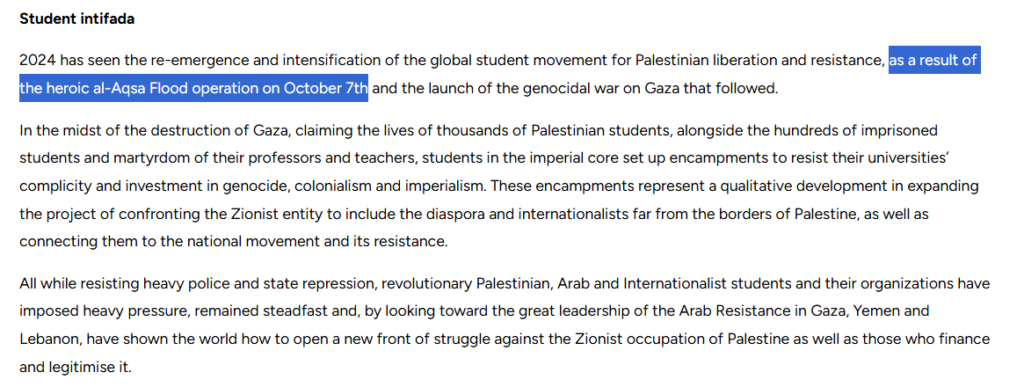
And this wasn’t written after the wave of American campus encampments following October 7th. Masar Badil’s founding declaration in 2021 already described students as one of the pillars of a wider revolutionary struggle and called for developing Palestinian student organizing politically, socially, intellectually and financially. By 2022, it was bringing together students and activists from the United States, Canada, Europe, Brazil and elsewhere as part of an effort to build a transnational student movement.
So while university administrators later treated each campus explosion like some spontaneous local phenomenon, Masar Badil had already spelled out the strategy: organize students, build campus networks and connect them internationally. That changes the picture a little.
Masar Badil’s Campus Connections Didn’t Stay Theoretical
Researchers at George Washington University’s Program on Extremism describe Masar Badil as part of a broader activist ecosystem and say it created its own youth and student network, Tariq El-Tahrir. GWU also identifies Students United for Palestinian Equality and Return, or SUPER-UW, as one of the groups Masar Badil has worked with through political education, campaigns, events and coordinated messaging. And SUPER-UW isn’t some hypothetical example buried in a network chart. It operates at the University of Washington.
In May 2025, SUPER-UW said it was occupying the university’s Interdisciplinary Engineering Building as part of a protest demanding that UW cut ties with Boeing. According to the university, protesters barricaded entrances, blocked nearby streets, vandalized the building and set dumpsters on fire.
Police eventually cleared the building and arrested dozens of people. The university said 21 arrested students were suspended and banned from campus. It also condemned what it described as an antisemitic statement from the suspended student group and said SUPER-UW’s statement celebrated the October 7th Hamas attacks.
Prosecutors later filed gross misdemeanor trespassing charges against 33 people arrested in connection with the occupation.
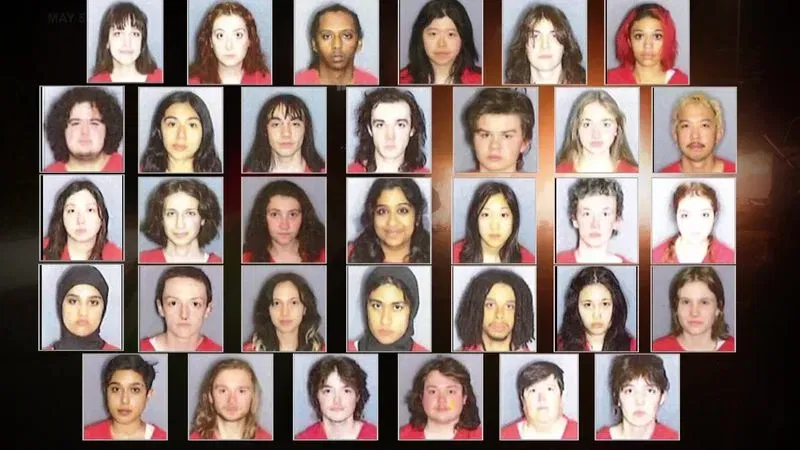
There’s no evidence that Masar Badil ordered that takeover, and we’re not claiming otherwise. But once you know Masar Badil explicitly set out to organize students internationally, the connection becomes a lot harder to wave away.
Hamas Was Watching Masar Badil’s Student Movement Too
Then there’s another layer. Masar Badil has hosted senior Hamas figures at its events. In May of 2024, Hamas official Osama Hamdan appeared in a Masar Badil webinar and praised the university encampments spreading across the United States, describing them as part of a student-led global intifada and praising those involved. None of that proves students at Columbia, UCLA, or the University of Washington were taking instructions from Hamas. But it does add context that universities largely ignored.

Masar Badil was openly talking about building student networks and connecting with campus groups, while Hamas officials were publicly applauding what those campus movements were becoming.
Masar Badil Makes the “Spontaneous Campus Protest” Story Harder to Believe
For the last few years, universities have mostly dealt with whatever was directly in front of them: an encampment, a building occupation, a chant, a disciplinary case, a masked protester. But what sits behind them.? Who is organizing students, connecting groups across campuses and countries, shaping political education, and treating universities not simply as places to protest, but as places to build a broader political movement?
Masar Badil answered at least part of that question itself. Its own materials show that students were part of the strategy from the beginning.
It worked to build international student networks, researchers documented cooperation with U.S. campus groups, and its events featured senior Hamas officials who openly praised the American encampment movement. Now the U.S. government says Masar Badil itself belongs to a sanctioned network tied to Samidoun and the PFLP.
None of that makes every student activist part of a terror network, and it would be irresponsible to suggest otherwise. But it does make the idea that every campus movement emerged spontaneously, independently and inside a sealed university bubble a lot harder to accept without question.
For years, administrators focused on the tents, the occupations, the chants, the vandalism and the arrests because those were the things happening right in front of them. The infrastructure around those movements required a little more curiosity. Masar Badil just gave universities a very good reason to start looking.