
Mahmoud Khalil is back in court, and this time he’s making an even bigger claim.
On July 14th, the former Columbia University protest organizer filed a federal civil rights lawsuit accusing senior government officials and several pro-Israel organizations of working together to monitor, silence, detain, and deport pro-Palestinian activists. The 131-page complaint names officials including Stephen Miller and Marco Rubio, along with the Heritage Foundation, Canary Mission, Betar, and several people connected to those groups.
Khalil’s lawyers claim private organizations gathered information on activists, promoted them as threats, and helped federal officials decide whom to target.
It’s a serious accusation. It’s also still an accusation that needs to be proven and currently lacks any basis of evidence.
What Is Mahmoud Khalil Claiming?
Khalil’s lawsuit argues that he was chosen because he had become one of the most recognizable figures connected to Columbia’s pro-Palestinian protest movement, and that in response, the federal government wanted to make an example of him and warn other foreign students that their immigration status could be used against them. The lawsuit relies partly on the Ku Klux Klan Act of 1871, which addresses conspiracies between private groups and government officials to deprive people of their civil rights.

That is a dramatic legal comparison. It also means Khalil must show an actual agreement between officials and the organizations named in the case, not just shared political goals.
How Are Project Esther and Canary Mission Involved?
A major part of the lawsuit focuses on Project Esther, a Heritage Foundation initiative released in October 2024. Heritage described it as a plan to fight antisemitism and dismantle what it called a “Hamas Support Network” operating through activist groups, funding networks, and universities. But Khalil’s lawyers describe it very differently, and argue that Project Esther offered a roadmap for treating pro-Palestinian activism as extremist activity and using federal power against organizers, especially foreign students.
Canary Mission is also directly named in the lawsuit. The organization runs an online database collecting activists’ public statements, affiliations, protest activity, and social media posts that documents people and groups that promote hatred of Israel, Jewish people, or the United States. Khalil’s complaint claims those profiles acted as dossiers that could be passed to government officials and used to identify activists for investigation or deportation. The lawsuit says Canary Mission profiled Khalil, highlighted his role in Columbia’s protest movement, and portrayed him as an extremist. His lawyers also point to reports that immigration officials reviewed the Canary Mission website while investigating student activists.
That may raise questions about how Khalil was selected, but it still certainly doesn’t prove an illegal conspiracy. Government agencies review public databases, news reports, social media, and advocacy-group research. Khalil has to prove that Canary Mission, Heritage, and federal officials actually coordinated to violate his rights.
Officials have argued that Khalil was removable under immigration law and raised allegations involving omissions or misrepresentations in his permanent residency application. Khalil denies those claims.
Is Mahmoud Khalil Putting the Campus Antisemitism Crackdown on Trial?
This case is about more than one arrest. Khalil is also trying to put the broader response to post-October 7th campus activism on trial. Under his version of events, organizations documenting activists, universities disciplining protesters, and federal officials examining visa holders were all part of one coordinated campaign to silence criticism of Israel. That argument skips over and conveniently ignores why the protest movement attracted scrutiny in the first place.
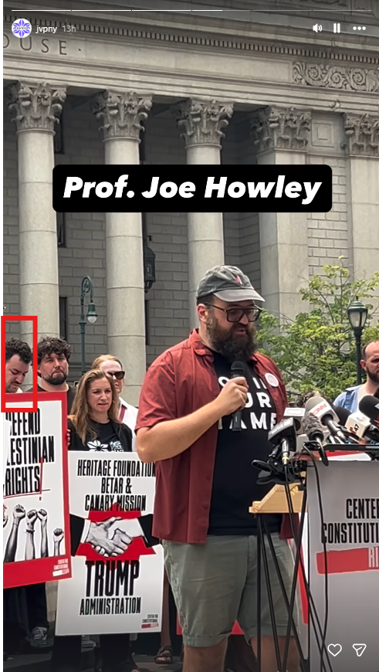
Campuses also saw encampments, building occupations, harassment complaints, threatening rhetoric, praise for “resistance,” and repeated attempts to shut down university operations. At Columbia specifically, the activism often went far beyond ordinary political debate. Professors and educators like Joseph Howley (who was even present and spoke at the July 14th press conference for Khalil’s lawsuit) played an active faculty role during the disruptive – and even violent – encampment protests of 2024.
Barnard professor Shayoni Mitra memorialized Refaat Alareer, who mocked the murder of Jewish children, in a campus event.
Columbia educator Hadeel Assali praised Gazan terror tunnels used to abduct and hold Israeli hostages as the “lungs” through which Gaza breathed.
And Professor Rosie Bsheer is currently reported to be in the running for the most influential Arab Studies position at Columbia despite being previously removed from a leadership role at Harvard over allegations of antisemitism.
Concerns about antisemitism and extremist organizing were not simply invented at Columbia.
Can Mahmoud Khalil Prove It?
A long complaint filled with alarming claims is not proof by itself. Khalil is accusing government officials, Heritage, Canary Mission, Betar, and other pro-Israel figures of joining one coordinated campaign against activists. Now comes the harder part: trying to prove that it actually happened.









