Who Is Patricia Alessandrini?
Patricia Alessandrini is an American composer and sound artist known for interactive, intermedial compositions and performance installations. She teaches at Stanford University’s Center for Computer Research in Music and Acoustics (CCRMA), where art and technology collide in experimental sound.
Outside the studio, though, Patricia Alessandrini has built a long record of political petition-signing and advocacy targeting Israel. Her involvement spans nearly two decades, from early cultural boycott campaigns in the mid-2000s to BDS-aligned academic divestment efforts and, more recently, genocide accusations during the Gaza war.
Students encountering her at Stanford aren’t just engaging with an avant-garde composer. They’re engaging with a faculty member who has consistently aligned herself with organized anti-Israel activism across multiple institutions.
Patricia Alessandrini’s Anti-Israel Petition and Letter-Signing
Patricia Alessandrini’s activism is well-documented through formal petitions and institutional letters, many of which call for boycotts, divestment, severing academic ties, or international investigations into Israel. Her timeline shows a consistent ideological pattern.
- July 2025 – she signed a petition urging the United Nations “to take a firm stand against tech sector complicity in grave violations of international law” and to end partnerships with tech companies allegedly complicit in Israel’s use of AI and cloud computing to commit “war crimes” in Gaza.
- October 2023 – she signed a petition by Scientists for Palestine calling for an immediate ceasefire in Gaza, saying “the only word to accurately describe the scale of unfolding events is ‘genocidal’” and demanding an end to what the petition called “collective punishment” of civilians.
- April 2022 – in a petition she signed calling for CUNY community members to sever academic ties with Israeli institutions, Israel’s existence was referenced as a “broader project of settler colonialism that has targeted Palestinian identity, land, life, and sovereignty.”
- July 2021 – Alessandrini signed a petition by CUNY staff, students, and faculty endorsing a system-wide academic and cultural boycott of Israel’s “violence and oppression of Israeli settler colonial and apartheid rule” and urging divestment and support for the broader BDS campaign.

- May 2021 – she put her name to a Stanford community letter condemning Israel’s “systematic destruction” of Palestinian homes and lives, criticizing Israeli policies as apartheid, and calling for support of the BDS movement.

- March 2020 – she signed a petition calling on scholars to refuse giving talks or guest lectures at any University of California campus until graduate students fired for strike-related activities were reinstated.

- September 2016 – she signed a Jewish Voice for Peace petition urging university faculty and admissions committees to condemn Canary Mission and refuse to use its list as a valid basis for judging applications or academic standing.
- May 2007 – she signed a BDS boycott petition urging artists and performers not to perform in Tel Aviv, saying “performing in Israel at this time is morally equivalent to performing in South Africa during the apartheid era.”
- November 2006 – she signed a petition demanding that Norman Finkelstein be afforded fair treatment, condemning what the petition described as Israeli “occupation.”
- August 2006 – signed a BDS petition calling on filmmakers, artists, and cultural workers worldwide to boycott Israeli cultural institutions and cancel exhibitions, performances, and collaborations in Israel.
The pattern is hard to miss. From cultural boycott to academic divestment to war crimes accusations, Patricia Alessandrini’s positions have remained remarkably consistent for decades.
And the language matters. “Genocide” and “war crimes” are the most serious legal accusations available in international law. Repeating and amplifying those claims positions Patricia Alessandrini firmly within the ecosystem of activism that frames Israel as a criminal state. For a Stanford faculty member teaching at a globally connected institution, sustained public alignment with those accusations raises questions about academic objectivity, especially in an environment where Jewish and Israeli students have reported feeling targeted or marginalized in broader campus discourse.
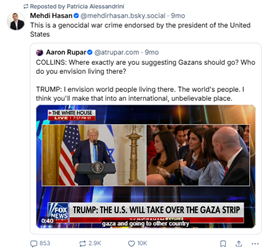
Conclusion: What Do Patricia Alessandrini’s Public Opinions Mean for Stanford?
Patricia Alessandrini’s record shows decades of consistent support for cultural boycotts, academic divestment, BDS-aligned campaigns, and accusations of genocide and war crimes against Israel. This is not a case of one emotional post during a breaking news cycle.
Academic boycotts, by definition, single out scholars and institutions based on nationality. If implemented institutionally, such positions could collide with university nondiscrimination principles and international collaboration policies. While signing petitions is protected speech, the cumulative pattern signals a faculty member deeply embedded in anti-Israel advocacy networks. At Stanford’s CCRMA, Patricia Alessandrini holds a position of influence in a globally connected academic space, and the question is whether such an entrenched record of boycott advocacy aligns with the university’s commitments to open academic exchange and viewpoint diversity.