Who Is Yasmine Khayyat?
Yasmine Khayyat is an Associate Professor of Arabic and Comparative Literature at Rutgers University. Her main faculty page has quietly disappeared, but she’s still listed across Rutgers platforms and continues to present herself as affiliated. So she’s still very much in the system, just with less visibility. Her academic focus is war, literature, and “resistance” in Lebanon. But her public record? Less academic distance, more consistent ideological alignment.
From years of backing academic boycotts of Israel to social media posts calling it “IsraH*LL,” and even criticizing the 9/11 Memorial, Khayyat’s position isn’t subtle. The pattern becomes hard to ignore and the question is raised: where does scholarship end and activism take over?
How Does Yasmine Khayyat Use Social Media to Show Her Bias?
Khayyat’s online presence and public activity drop any remaining academic neutrality that could be cited. When a professor makes extreme posts, it has to be questioned how they can claim neutrality in the classroom, especially when teaching courses on Arabic studies.
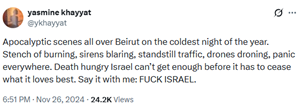
- November 2024 – on X, she wrote, “Death hungry Israel can’t get enough…Say it with me: F*** ISRAEL.” She also reposted Susan Abulhawa, an author associated with Penn who has posted flagrantly antisemitic conspiracy theories.

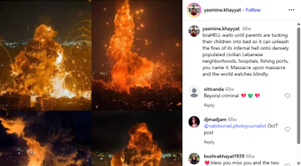
- October 2024 – on Instagram, she wrote “IsraH*LL waits until parents are tucking their children into bed so it can unleash the fires of its infernal hell…”
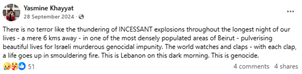
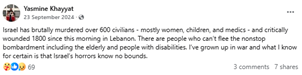
- September 2024 – in posts on Facebook, she wrote, “Pulverising beautiful lives for Israeli murderous genocidal impunity…” and “Israel’s horrors know no bounds.”
What Has Yasmine Khayyat Supported Through Petitions and Boycott Campaigns?
Her signature history shows long-term alignment with boycott movements targeting Israeli institutions, as well as criticism for the 9/11 Memorial.
- October 2023 – just days after the events of October 7th, she signed an open letter criticizing Rutgers leadership for focusing “too much” on Israeli victims after October 7th and calling for greater emphasis on Palestinian suffering, saying “while we cannot know your intentions, it conveyed to our students that you had clearly chosen a ‘side.’” The letter was also signed by Rutgers faculty member Sahar Aziz, whose Center for Security, Race and Rights has been under investigation for antisemitism.
- May 2021 – she signed a faculty letter condemning Israel’s “settler-colonial policies” and advocating for Palestinian rights and decolonization from “structural violence and inequality.” That letter was also signed by Rutgers colleague Noura Erakat, who has spread antisemitic theories.
- 2016 – she signed a petition urging the Modern Language Association to endorse an academic boycott of Israeli institutions.
- September 2014 – in signing another public statement, she pledged, in direct alliance with the BDS movement, “not to collaborate on projects and events involving Israeli academic institutions, not to teach at or to attend conferences and other events at such institutions, and not to publish in academic journals based in Israel.”
- August 2014 – she signed yet another call reinforcing the boycott of Israeli academic institutions.
- May 2014 – she signed a letter criticizing the National September 11th Memorial & Museum over concerns about how it portrayed Islam and terrorism in its featured film, “The Rise of al-Qaeda” arguing that using the terminology “Islamist extremism/terrorism” and “jihadism” would “stigmatize” Muslims.
How Has Yasmine Khayyat Promoted Anti-Israel Activism Through Academia?
Khayyat’s academic appearances consistently reinforce a single idea: that Israel is framed as the primary driver of regional harm and disruption.
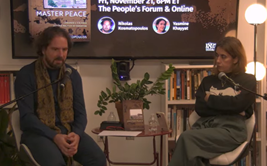
- November 2025 – in participating in a book talk on her husband’s work Matster Peace, she supported his accusations of Israel of targeting intellectuals and violating ceasefires. Her husband had previously written about his “exclusion from Greek media” due to “refusal to ascribe to the mainstream media discourse about ‘Hamas terrorism.’”
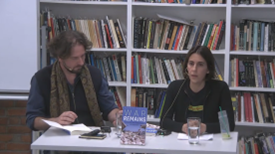
- May 2023 – during a book talk for her book War Remains, she described Israel as an occupier responsible for Lebanon’s destruction in 2006 and repeatedly condemned its actions as violent rather than defensive.
What Has Yasmine Khayyat Published About Israel and Conflict?
Her publications consistently center Israel as the dominant force shaping “cultural trauma” in the region, without acknowledging Hamas or Hezbollah terrorist instigation or acts.
- April 2025 – she wrote a piece recounting life during the Israel–Lebanon conflict, emphasizing Israeli airstrikes, civilian casualties, and the killing of Hezbollah leader Hassan Nasrallah (which she alluded was a negative event). She also cited the “Israeli pager attack on Lebanon” while failing to acknowledge that the targets were Hezbollah militants.
- May 2023 – her book War Remains: Ruination and Resistance in Lebanon explored how Lebanese artists and writers transform war ruins into sites of resistance, again centering Israel’s role in regional destruction.
Conclusion: How Can Yasmine Khayyat Impact Rutgers University’s Funding?
Yasmine Khayyat’s record points to a consistent overlap between academic authority and political advocacy. That alone isn’t unusual. The issue is the one-sidedness and the escalation in tone, from boycott campaigns to explicit hostility online. At a university like Rutgers, which operates under Title VI obligations related to its federal funding, questions are raised about classroom balance and campus climate. This isn’t about one statement or one petition. It’s the pattern. Rutgers may still list her as faculty, but it’s fair to ask whether this reflects scholarship or sustained activism carried into the classroom.